To get the exploration for the class go to the website to "Student Handouts" and you can find it under chapter 4, it is called "Exploration 4-5A_Derivative of the Inverse of a Function_10.pdf".
So in the last class, which was Virtual Wednesday, we began exploring the Derivative of the Inverse Function. There was a choice of whether to be in class or not, so how did your virtual calculus class go?

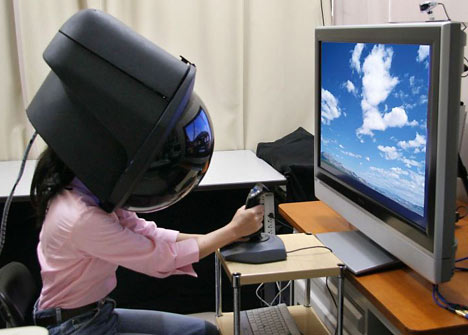
From: http://teamsubmarine.files.wordpress.com/2009/07/virtual-reality-helmut.jpg
I hope it went well and if it didn't then I hope I can help!
Our Objective: Discover the unique relationship between the derivative of a function and the derivative of the inverse of the function.
Part I.
To begin the lesson we reviewed.
Inverse of a real number - - An additive inverse, known as the opposite of the number. ex. -3 and 3
- A multiplicative inverse, known as the reciprocal of the number. ex. ⅓ and 3
Inverse Operations - an Inverse Operation is used to "undo" the other operation.
- Subtraction is the inverse of Addition
- Roots are the inverses of Squared Roots
- Sin-¹(x) is the inverse of sin(x)
- Multiplication is the inverse of division
- And logarithms are the inverses of power functions
And Inverses of a Function! - How to determine if a relation is the inverse of a given function.
- Numerically - the X and Y values are interchanged in a table
- Graphically - The reflection over the line y=x
- Algebraically - By using the inverse operations
So now vocab test...If a function's inverse is also a function it is
_______(look at the bottom for the answer)
That means that it is a
one-to-one function. So remember how a function is "for every x there is a unique y"? A one-to-one function just switches the x and y, so it is "for every y there is a unique x".
If you are ever wondering if a function's inverse will be a function just do the
horizontal line test, which will tell you if the function's inverse will or won't be a function.
Part II.So the second part to all of the review of inverse functions is the derivative of the inverse of a function.
The problem that I found most helpful for learning this is the first on that part of the exploration:
y=3+4xnow find it's inverse function,
to do that interchange the y and x,
x=3+4ynow solve for the new y,
y=(x-3)/4 or y= (1/4)x-(3/4)Since we now have the inverse function we can find the derivative and the derivative of the inverse function. f '(x)= 4 and (f -¹)'(x)= (1/4)And these are...
RECIPROCALS!!!after doing many more like these we came up with our own conjectures of what this all means...
My Conjecture: The derivative of a function is the reciprocal of the derivative of the inverse function. General Formula for the Derivative of the Inverse of a Function:In symbols: If
f(x) is an invertible function then for any point (a,b) on
f(x)


In words: For any point (a,b) on an invertible function, the derivative of the inverse of the function evaluated at b is equal to the reciprocal of the derivative of the function evaluated at a.

Here in the slide show is the general formula for the derivative of the inverse of a function. I think this is really helpful to go over just to get it in your head.

This is what we did in class, the remainder of the exploration was homework and here are a few things just to help out,
- To write the equation of the tangent line use point slope form: y=m(x-h) + k where (h,k) are your points and m is your slope.
- Vocab - Mirror points, means if you have points (a,b) the mirror points are (b,a).
- Always check your answers, either on nDeriv or just look at the slides from class.
- Or we could just say "Look before you leap..."

From:
http://victorysugar.sulekha.com/mstore/victorysugar/albums/default/look%20before%20u%20leap.JPGBecause if you don't that fish could be laughing at you.
Great, well I hope this was helpful for everyone, please leave me comments on what worked and what didn't!
Beston
Oh and the next scribe is Flying Slug :)
vocab answer= invertible




 Posts
Posts


